
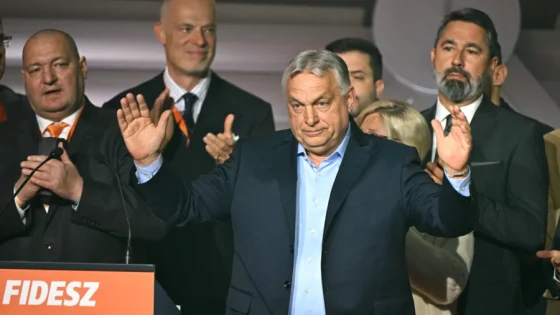
Hungarian Prime Minister Viktor Orbán conceded defeat in the parliamentary election held on April 12, 2026, marking the end of his 16-year tenure. The opposition Tisza Party, led by Péter Magyar, is projected to secure a significant victory, potentially gaining a two-thirds majority in the 199-seat National Assembly [1][2].
With approximately 77% of votes counted, early results indicated that the Tisza Party had garnered over 53% of the vote, compared to 38% for Orbán’s Fidesz party [1][3]. The election witnessed a record voter turnout of about 77%, the highest in Hungary’s post-Communist history [1][4].
Péter Magyar, a former Fidesz insider who founded the Tisza Party in 2024 after breaking with Orbán’s party, received a congratulatory phone call from the outgoing prime minister, acknowledging the election outcome [2][5].

What Is Known
The Tisza Party’s projected victory marks a significant shift in Hungary’s political landscape, potentially ending Orbán’s long-standing influence. The high voter turnout reflects increased public engagement in the electoral process [1][4].
What Remains Unclear
While projections suggest a two-thirds majority for the Tisza Party, exact seat counts remain unconfirmed, with various sources reporting different figures. Official results are yet to be finalized [6].
This article was generated by Bluxle's AI system based on research from multiple news sources. All facts are sourced and cited below. The AI is designed to be neutral and fact-based with no editorial opinion.
Sources & Citations
Weighted by citation frequency — sources cited more often carry greater influence.
Research Basis
Outlets in bold were actively consulted during research for this article. Others are in our standard monitoring pool.
Report an Issue
Tell us what you noticed. Our editors will review it.
✓ Report received. Thank you!