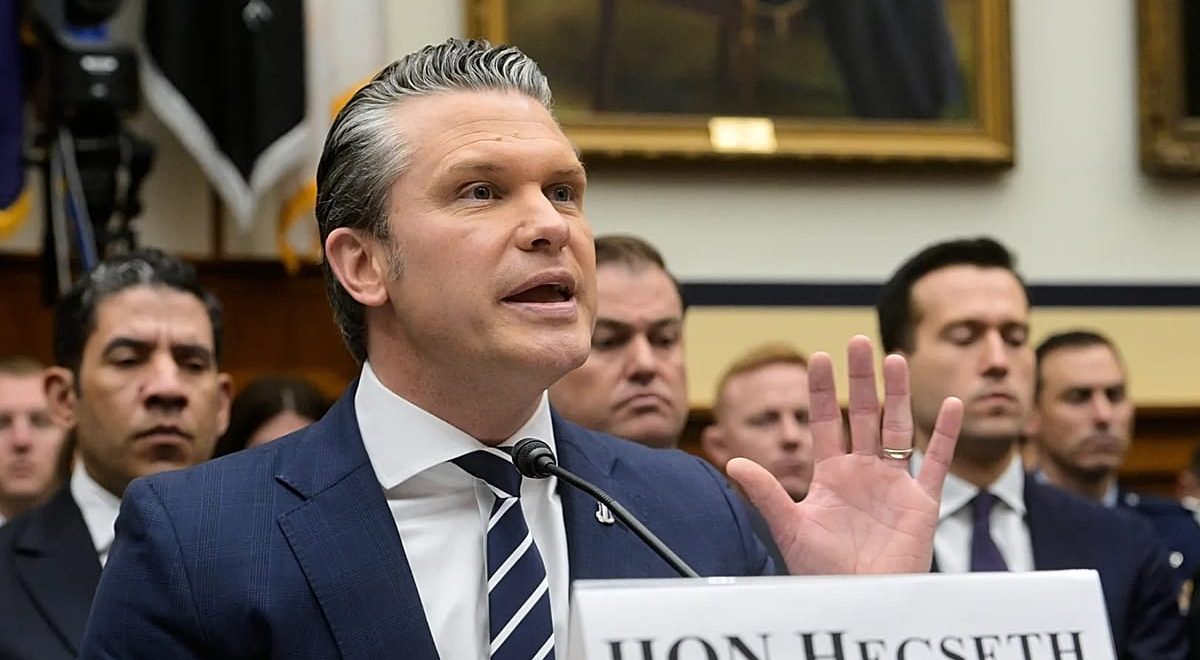
Defense Secretary Pete Hegseth testified before the House Armed Services Committee on April 29, 2026, marking his first public congressional appearance since the onset of the Iran war. The hearing, which lasted nearly six hours, covered a range of topics including the financial cost of the conflict, military leadership changes, and strategic outcomes [1].
According to figures presented during the hearing, the Iran war has cost approximately $25 billion to date [1]. Hegseth, alongside Chairman of the Joint Chiefs of Staff Gen. Dan Caine, defended the Trump administration’s proposed 2027 defense budget of $1.5 trillion, emphasizing the need for continued military readiness [2].
Lawmakers questioned Hegseth about the justification for the war, highlighting apparent contradictions between earlier claims that Iran’s nuclear facilities were “obliterated” and later statements that Iran still posed an imminent nuclear threat [1]. Hegseth maintained that Iran had “begged” for a ceasefire and described Operation Epic Fury as a “decisive U.S. victory” that rendered Iran’s military combat ineffective [3].
Hegseth also addressed his decision to remove several senior military leaders, including Army Chief of Staff Gen. Randy George and Navy Secretary John Phelan, stating that “new leadership” was necessary [1]. He characterized critical remarks from lawmakers as “reckless, feckless and defeatist,” accusing them of providing propaganda to enemies [1].
Despite asserting U.S. air dominance, Hegseth acknowledged that while air defenses have been enhanced, they “can’t stop everything” that Iran fires [2]. His claims of uncontested air dominance were disputed by reports of the downing of a U.S. F-15E fighter jet and an A-10 attack plane, raising questions about the accuracy of his statements [4].
What Is Known
The Iran war has cost approximately $25 billion so far, and the proposed 2027 defense budget stands at $1.5 trillion [1][2]. Hegseth has made significant changes in military leadership, citing the need for new direction [1].
What Remains Unclear
Discrepancies in Hegseth’s statements regarding Iran’s nuclear threat and U.S. air dominance remain unresolved. His claims about the effectiveness of U.S. operations and Iran’s military capabilities continue to be debated [1][4].
This article was generated by Bluxle's AI system based on research from multiple news sources. All facts are sourced and cited below. The AI is designed to be neutral and fact-based with no editorial opinion.

Sources & Citations
Weighted by citation frequency — sources cited more often carry greater influence.
Research Basis
Outlets in bold were actively consulted during research for this article. Others are in our standard monitoring pool.
Report an Issue
Tell us what you noticed. Our editors will review it.
✓ Report received. Thank you!